
 05 July 2022
Why Rural Markets Feel Small to Suppliers, Even When Demand Is Massive
In many agricultural companies, rural markets are often described the same way:
fragmented
low-volume
difficult to serve
expensive to coordinate
hard to forecast
For suppliers trying to scale distribution, rural demand can appear commercially thin and operationally unpredictable.
A supplier may successfully move products into a district warehouse yet still have little visibility into whether those products consistently reached village retailers, which products moved fastest, or where stockouts emerged first during planting season.
By the time demand becomes visible through traditional ordering systems, replenishment often becomes reactive instead of coordinated.
And so rural markets can begin to feel commercially small.
Yet this creates a striking contradiction.
Because agriculture is already deeply embedded within rural economies.
Farmers consistently purchase seed, fertiliser, crop protection products, crop storage products, livestock inputs, and farming tools season after season. Rural populations remain large. Agricultural activity is continuous. Purchasing behaviour already exists across thousands of communities.
So why do rural markets still appear commercially weak to many suppliers?
The answer is not weak demand.
It is weak visibility.
The Illusion of Small Rural Markets
Across rural regions, agricultural demand already exists at a meaningful scale.
But unlike urban commerce, rural demand is distributed across:
- villages
- dukas
- cooperatives
- trading centres
- informal retail channels
- seasonal purchasing cycles
The result is that demand rarely appears concentrated in ways traditional distribution systems can easily measure, aggregate, or coordinate.
And dispersed demand often appears smaller than it truly is.
A supplier may look at one rural retailer and see low transaction volume. But across hundreds or thousands of similar retail points, aggregate demand becomes substantial.
In rural agriculture, some of the largest markets are often the least visible.
What suppliers often interpret as weak rural demand is frequently weak rural coordination.
Rural Demand Is Often Weakly Visible Inside Existing Distribution Systems
Many agricultural distribution systems were originally designed around:
- centralized dealers
- urban retail concentration
- bulk movement models
- concentrated trade routes
But rural commerce behaves differently.
Demand signals emerge across highly distributed retail environments with limited aggregation and inconsistent coordination.
As a result, suppliers often face:
- weak village-level visibility
- fragmented retailer ordering
- inconsistent replenishment cycles
- poor forecasting accuracy
- limited sell-through intelligence
- inefficient last-mile servicing
This creates operational uncertainty throughout the supply chain.
Inventory allocation becomes harder. Route density weakens. Stock imbalances increase. Working capital efficiency suffers. Retail servicing costs rise.
And when visibility remains weak, rural demand itself begins to appear commercially unreliable.
But the issue is often not a demand weakness.
It is signal fragmentation.
The Real Constraint Is Coordination
One of the biggest structural challenges in rural agriculture is that demand exists continuously, but coordination remains inconsistent.
Suppliers may know farmers are purchasing products somewhere across rural markets, yet still lack reliable visibility into:
- localized demand patterns
- seasonal purchasing behaviour
- retailer movement trends
- inventory performance at the village level
- replenishment timing across dispersed retail networks
Without this visibility, rural markets become difficult to coordinate efficiently at scale.
This creates a self-reinforcing cycle.
Because when coordination is weak:
- suppliers hesitate to deepen rural penetration
- servicing becomes reactive instead of predictive
- retailers experience inconsistent stock availability
- farmers face uncertainty
- purchasing behaviour becomes fragmented
- demand visibility weakens even further
What appears fragmented at first glance can become highly efficient when coordinated properly.
Thousands of deeply embedded rural retail points create proximity to farmers that centralised distribution systems often struggle to replicate.
The challenge is not the existence of rural retail density.
The challenge is coordinating it intelligently.
Village Dukas Are More Important Than They Appear
This becomes especially visible at the level of village dukas.
Across rural communities, dukas already function as deeply embedded rural commerce infrastructure. These retail points move household essentials every single day:
- sugar
- soap
- cooking oil
- airtime
- beverages
- dry foods
- baby diapers
They operate close to farmers, understand local purchasing rhythms, and maintain continuous engagement with surrounding communities.
Yet agricultural distribution systems have historically remained weakly integrated into these retail environments.
As a result, agricultural purchasing remains fragmented across:
- towns
- agro-dealer clusters
- disconnected supply routes
- seasonal retail channels
The irony is significant.
The rural retail layer already exists.
What has often been missing is the coordination infrastructure connecting agricultural supply to it consistently, predictably, and intelligently.
Distribution Intelligence Is Becoming a Competitive Advantage
For years, agricultural competition focused primarily on:
- product quality
- manufacturing capacity
- pricing
- brand penetration
All of these remain important.
But increasingly, rural market scalability depends on something else:
distribution intelligence.
Because suppliers who can see rural demand more clearly gain advantages in:
- forecasting accuracy
- inventory deployment
- replenishment efficiency
- retailer coordination
- route optimization
- market responsiveness
As rural agricultural markets continue expanding, suppliers with stronger rural visibility and coordination systems may gain significant long-term advantages in retailer penetration, forecasting precision, and market responsiveness.
In other words, rural distribution is no longer only a logistics function.
It is becoming an intelligence function.
The suppliers who scale rural markets most effectively may not simply manufacture better products.
They may build better systems for understanding, coordinating, and serving distributed rural demand.
Making Rural Demand More Visible
This is part of the challenge Farmerstack is working to solve.
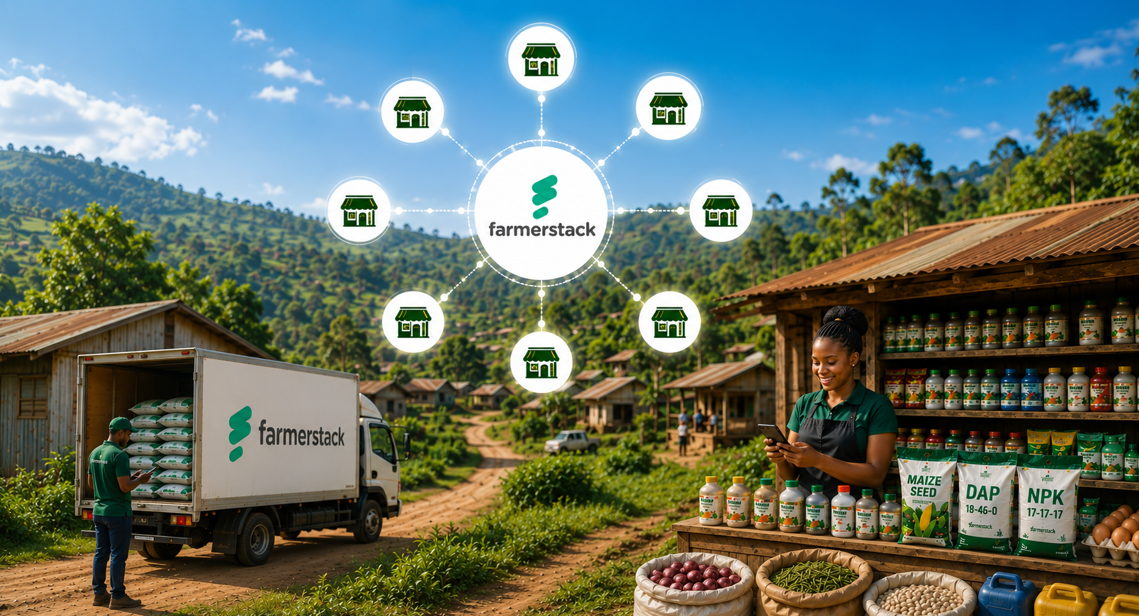
Farmerstack operates as a demand-driven last-mile distribution network connecting suppliers to rural communities through village dukas and cooperatives.
But the larger objective extends beyond product movement alone.
Across its growing network, Farmerstack aggregates demand signals from village-level retail activity to improve inventory coordination, local availability, and supplier visibility into underserved rural markets.
The system is designed to strengthen:
- rural demand visibility
- retailer coordination
- localised inventory intelligence
- seasonal supply responsiveness
- last-mile distribution predictability
By aggregating demand signals across distributed rural retail environments, suppliers gain clearer visibility into how products move within underserved agricultural markets.
That creates stronger coordination between:
- suppliers
- inventory systems
- retail networks
- local demand behaviour
Over time, rural markets become easier to forecast, easier to replenish, and more economically efficient to serve.
The Bigger Shift
Rural agricultural markets are often described as “hard to reach.”
But many rural markets are not unreachable.
They are weakly visible within existing distribution systems.
The farmers already exist.
The retail activity already exists.
The purchasing behaviour already exists.
What remains underdeveloped is the infrastructure that transforms fragmented rural activity into coordinated market intelligence.
That distinction matters enormously.
Because rural demand does not become powerful only when products are manufactured.
Rural demand becomes powerful when it becomes visible, coordinated, and consistently serviceable at scale.
The next era of agricultural growth may not be defined only by better products.
It may be defined by better systems for seeing, coordinating, and serving the rural economies that have long existed in plain sight.