
 05 July 2022
The Best Rural Businesses Are Often the Least Visible to Financial Systems
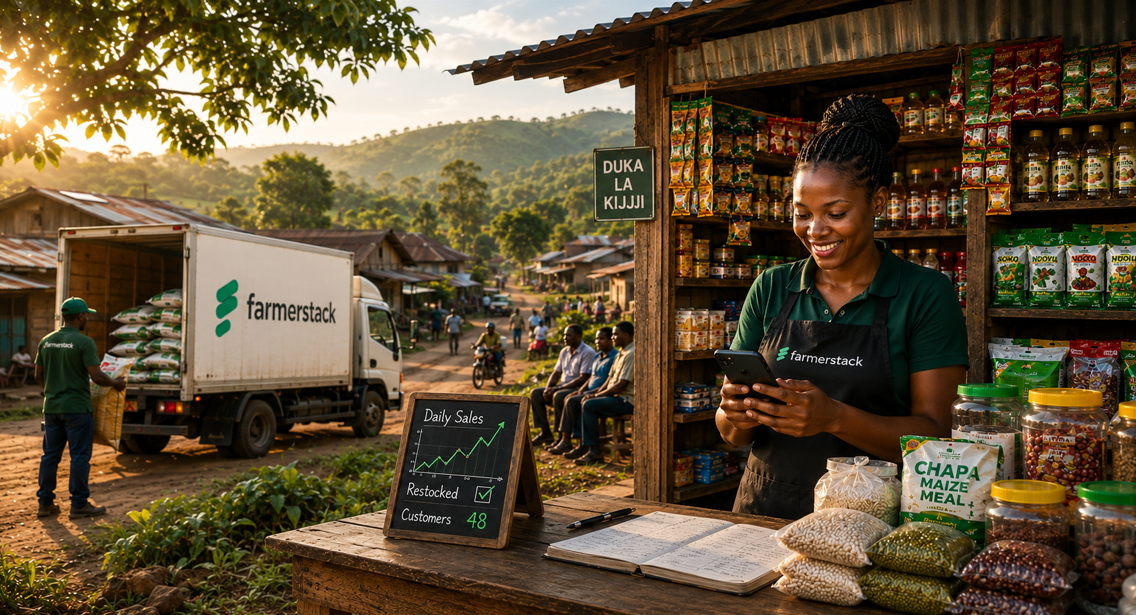
Every morning across rural communities, village dukas open before sunrise.
By midday, they have already served dozens of customers buying sugar, soap, cooking oil, airtime, beverages, and household essentials. During planting seasons, farmers also stop by searching for seed, fertiliser, livestock inputs, or crop protection products.
Some of these shops operate every single day of the year. Many have served their communities for years. They understand local demand patterns, seasonal purchasing behaviour, harvest cycles, and rural cash flow realities with remarkable precision.
Yet many of these same businesses remain almost invisible to formal financial systems.
They struggle to access working capital.
They rarely qualify for meaningful inventory financing.
They are often considered too informal, too small, or too difficult to underwrite.
And so one of the most important contradictions in rural economies continues quietly in plain sight:
Some of the businesses closest to agricultural activity remain among the least visible to banks, financiers, and formal credit systems.
Rural Commerce Is Larger Than It Appears
Across many rural communities, village dukas already function as deeply embedded merchant infrastructure.
They are not simply small shops.
They are:
- daily transaction networks
- local inventory distribution points
- liquidity circulation hubs
- seasonal commerce nodes
- trusted retail access points
- highly localised market intelligence systems
In many villages, people interact with the local duka more consistently than they interact with any formal institution.
The duka already understands:
- when planting seasons begin
- which products move fastest
- when local liquidity tightens
- how harvest cycles affect purchasing behavior
- which households buy consistently
- when agricultural demand begins increasing
A village duka may restock sugar several times in a week, purchase seed ahead of planting season, extend small informal credit to trusted customers, and maintain steady daily transaction activity for years — yet still remain financially invisible to formal lenders.
This is not marginal economic activity.
It is a continuous commercial activity occurring across thousands of distributed rural retail points every day.
But much of it remains weakly measurable within formal financial systems.
The Real Challenge Is Not Commerce — It Is Visibility
Rural businesses are often perceived as:
- fragmented
- unpredictable
- operationally risky
- difficult to finance
But in many cases, the deeper issue is not the absence of economic activity.
It is the absence of systems capable of seeing that activity clearly.
Financing follows visibility.
Traditional underwriting systems were designed around:
- formal financial statements
- audited records
- collateral structures
- digitised banking histories
- standardized reporting
Rural commerce rarely behaves that way.
Village dukas often operate through:
- fragmented cash transactions
- small but continuous purchases
- seasonal inventory cycles
- mixed household and business cash flows
- informal supplier relationships
- localised trust-based commerce
As a result, many commercially active rural businesses appear financially thin on paper — even when they demonstrate years of operational resilience and consistent local demand.
This creates a major visibility gap.
A duka may:
- move inventory daily
- replenish stock consistently
- maintain stable customer relationships
- survive difficult agricultural seasons
- generate recurring transaction activity
yet still remain difficult for formal institutions to evaluate confidently.
Many rural businesses are not excluded because they lack commercial activity.
They are excluded because formal systems still struggle to measure distributed commerce efficiently.
Why This Matters More Than We Think
The financial invisibility of rural merchant networks creates consequences far beyond individual shops.
When rural retailers lack sufficient working capital:
- inventory becomes inconsistent
- stockouts increase
- supplier coordination weakens
- seasonal demand becomes harder to serve
- agricultural access deteriorates
- farmers travel farther searching for products
And because agriculture is highly seasonal, even short financing gaps can disrupt:
- planting timelines
- input availability
- local inventory readiness
- supplier forecasting
- product movement efficiency
Reliable agricultural systems depend not only on products and logistics.
They also depend on financially resilient local retail networks capable of maintaining inventory consistency close to farming communities.
What appears fragmented at the individual level often becomes highly significant at network scale.
A Structural Shift Is Beginning
For decades, rural commerce remained difficult to observe clearly at scale.
But that may now be changing.
For the first time, rural retail coordination, distribution activity, inventory movement, and merchant-level transaction patterns are becoming increasingly observable through more structured distribution systems.
This matters because visibility changes underwriting.
As rural distribution systems become more coordinated and data-informed, previously invisible commercial activity begins becoming easier to understand:
- inventory movement
- replenishment frequency
- seasonal demand cycles
- retailer consistency
- transaction rhythm
- product turnover behaviour
These are not merely operational signals.
They are underwriting signals.
And increasingly, coordinated distribution systems are beginning to function as underwriting infrastructure for rural commerce.
Over time, this creates the foundation for:
- inventory financing
- embedded finance
- supply chain finance
- merchant lending
- rural risk assessment
- more intelligent capital allocation
Because the more measurable rural commerce becomes, the more financeable it becomes as well.
The Future of Rural Finance May Begin Inside Distribution Networks
This is part of the longer-term opportunity that Farmerstack is beginning to unlock.
Farmerstack operates as a demand-driven last-mile distribution network connecting manufacturers, village dukas, cooperatives, and rural farming communities.
But beyond product movement, something more significant begins to emerge over time:
commercial visibility.
As rural retail systems become more coordinated, structured, and observable, informal commerce begins to develop clearer operational patterns.
Inventory behaviour becomes easier to track.
Demand cycles become easier to forecast.
Merchant consistency becomes easier to understand.
Supply coordination becomes easier to optimise.
And gradually, previously fragmented rural commerce begins functioning more like a coordinated merchant infrastructure.
This changes how rural markets can eventually be understood by:
- banks
- embedded finance companies
- agri-finance funds
- supply chain financiers
- development finance institutions
- manufacturers
- insurers
- philanthropic organizations
Because individually, rural retailers may appear operationally small.
Collectively, coordinated rural merchant networks create large-scale commercial ecosystems with significant aggregate transaction activity.
The future of rural finance may therefore depend less on building entirely new rural businesses —
and more on building better systems for understanding the businesses that already exist.
The Bigger Opportunity
For decades, rural businesses have often been viewed primarily through the lens of informality and risk.
But many village dukas are already performing critical economic functions every single day:
- distributing goods
- circulating liquidity
- supporting agricultural activity
- coordinating local commerce
- sustaining rural demand systems
The challenge is that formal systems have historically lacked the infrastructure needed to measure these networks clearly.
That may now be changing.
And increasingly, the institutions capable of understanding distributed rural commerce more intelligently may gain access to one of the largest undercoordinated merchant ecosystems in agriculture.
The shops already exist.
The customers already exist.
The transaction activity already exists.
What remains underdeveloped is the infrastructure that transforms everyday rural commerce into visible, measurable, and financeable economic systems.
Because rural commerce is not inherently unfinanceable.
It has often simply remained under-visible.
And the next frontier in rural finance may not be creating entirely new economic activity.
It may be learning how to finally see the economic systems that already exist.