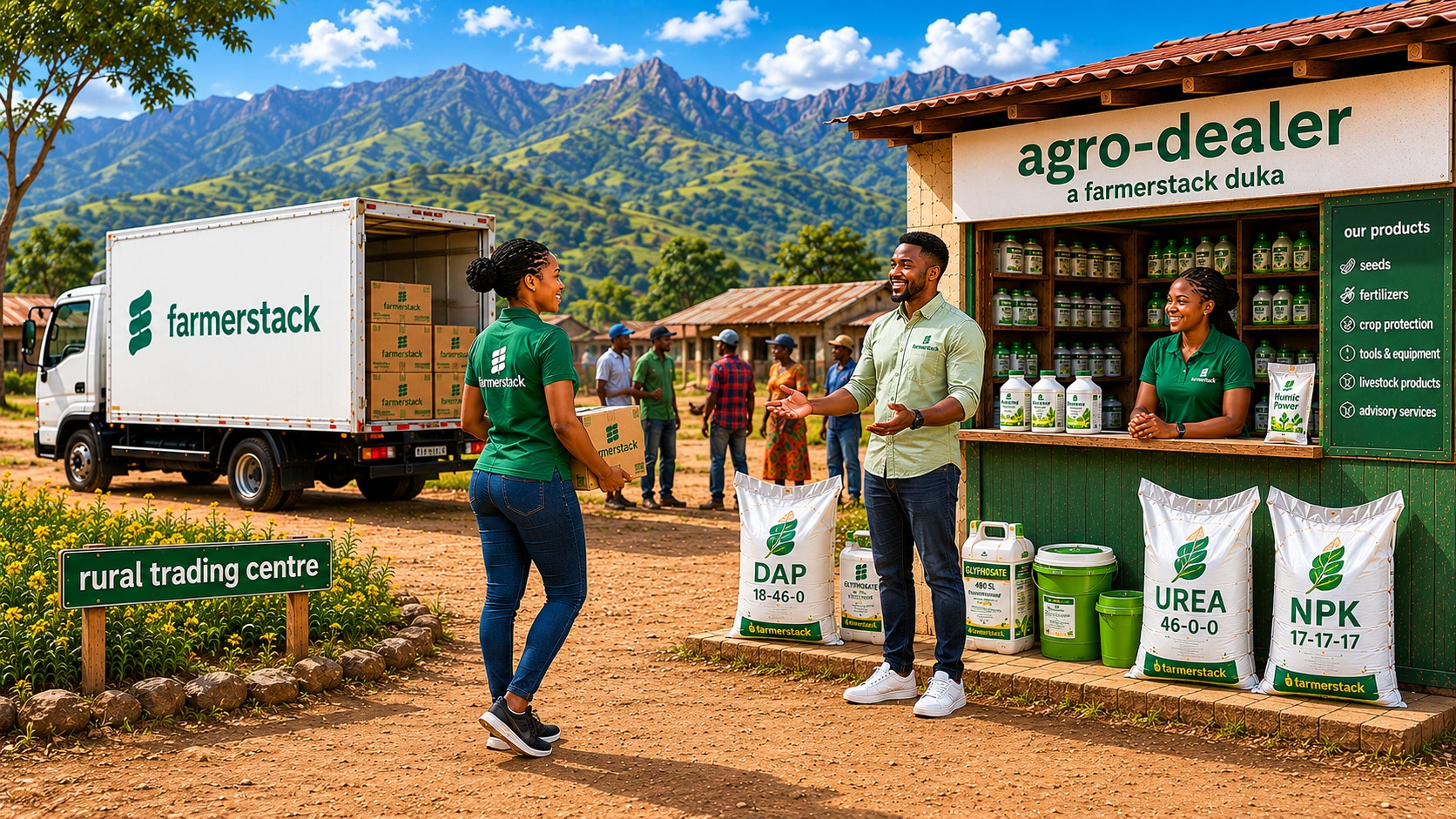
Farmerstack is the distribution layer connecting suppliers to rural markets. We move agricultural inputs through a structured network of village shops and cooperatives—so farmers can access what they need, when they need it, close to where they live.
Farmerstack is built on real demand—capturing what farmers are buying, and using that to coordinate supply, inventory, and last-mile delivery across the system.
Because when distribution works, everything works.
Farmers produce more. Local businesses grow. Suppliers scale into new markets.
Farmerstack began with a simple, frustrating reality:
Farmers were doing everything right—but still couldn’t access the inputs they needed.
In many communities, farmers travel long distances to the nearest town, spend money on transport, and still face uncertainty: products out of stock, prices too high, or inputs that simply don’t work.
At the same time, village shops—dukas—are right there. Close to farmers. Trusted by the community.
But they lack reliable supply, the right products, and confidence in what they sell.
And suppliers? They have products—but no efficient way to reach the last mile.
The problem isn’t demand. The problem is distribution.
So, we built Farmerstack—not just to sell inputs, but to fix the system behind how they reach farmers.
Supported by
OUR JOURNEY
Building the System
2023
______
We incorporated in Uganda and won the D-Prize Global Distribution Challenge—validating the need to fix rural distribution.
2024
______
We launched our pilot with early duka partners in Tororo, Eastern Uganda—testing and refining the model on the ground.
2025
______
We expanded the network across rural communities—growing our reach and strengthening distribution.
Now
______
We are scaling distribution and deepening partnerships with suppliers, funders, and ecosystem supporters—building a system that works at scale.